
A Shopify store locator for your stockists.
Turn stockists, retailers and pickup points into a searchable locator that feels native to your storefront. Install the app from the Shopify App Store, add the Store locator block in the theme editor, and filter by product with online sellers kept clear.
Designed to match your Shopify site.
Style it yourself, or send us your site and we match it for you, free on every paid plan.
- 7-day free trial
- No coding needed
- Free brand matching
- From $19/month
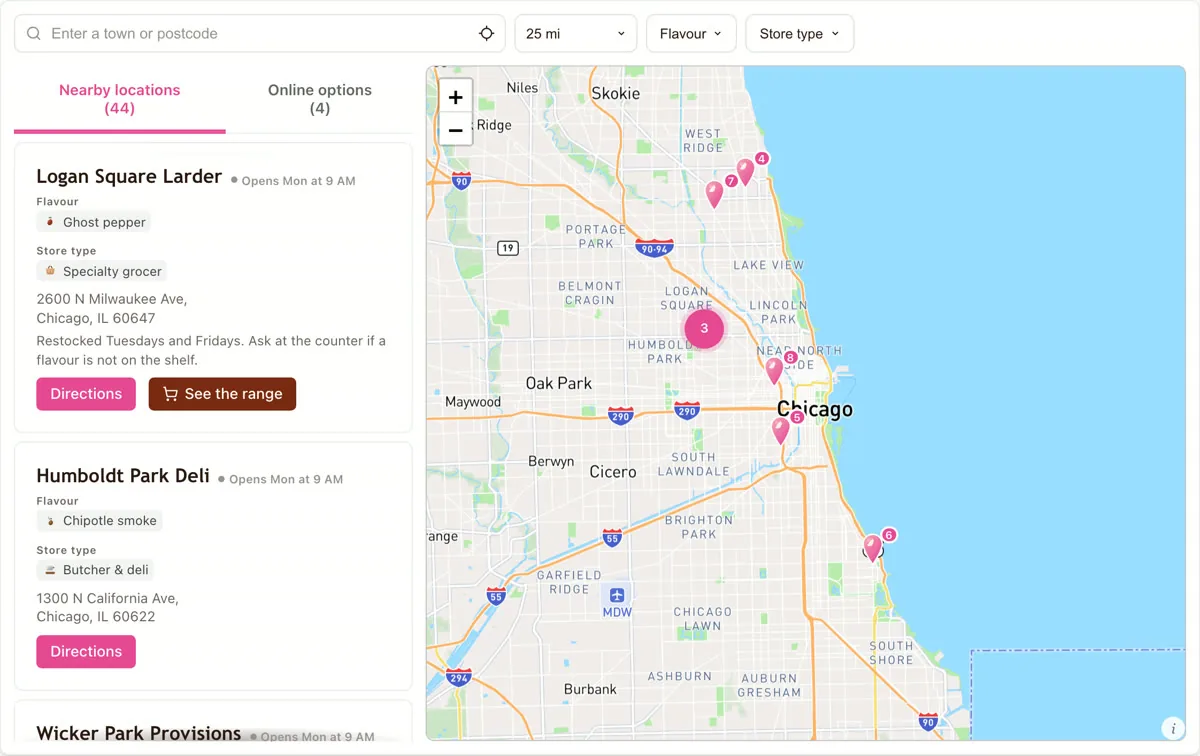
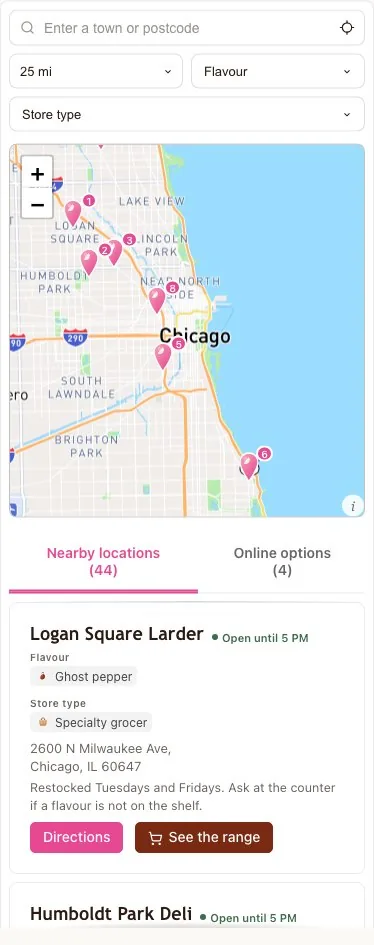
A real locator capture. This version is designed for a product brand with hundreds of retailers and customers searching for a specific flavour or range. Open the full-size example to search it. Ember & Vine is an invented concept brand using sample data.
Shopify details
Keep the storefront simple. Manage the locator elsewhere.
Add the locator with the Store locator block from our Shopify app, then keep locations, stockist fields and search behaviour in Handled. Your theme stays focused on shopping while the locator stays easy to update.
- Install from the Shopify App Store and place the block in the theme editor.
- Show product, stockist and pickup details with filters.
- Update locations without editing theme code again.
Built around the search
A Shopify store locator built around what shoppers are trying to buy.
Distance matters, but it is rarely the only question. Give the shopper enough information to choose a useful stockist before they leave your site.
- 01
Search by product, not only postcode.
Turn product ranges, retailer types or services into filters, so a nearby result is also one that carries what the shopper wants.
- 02
Keep online and nearby options clear.
Show physical stockists on the map while keeping online sellers available as a separate route instead of mixing two different journeys.
- 03
Change it without reopening the theme.
The Shopify page keeps the same embed. Update locations, filters, wording and design later from the Handled dashboard.
Search and discovery
A visitor finds the nearest useful location without scanning the whole list.
The locator opens, the visitor types a town or postcode, and results reorder by distance. Search, filters, labels and layout are settings you control, not fixed behaviour.
Start with the spreadsheet you already maintain. Import a CSV, review the locations, then keep the same embed as the list changes.
North Loop Cycles
1.2 mi · Open until 6:00
Eastside Bike Works
2.8 mi · Open until 7:00
Hill Country Service
4.6 mi · Opens tomorrow
Search stage: Austin locations are filtered to repair shops, sorted by distance, and the nearest result offers directions.
Install on Shopify
Add the Shopify store locator to a page once.
Install Handled Locator from the Shopify App Store, add its Store locator block to your locations page in the theme editor and paste your site ID. Prefer no app? Paste the embed code into the page with Show HTML instead.
App Store app, or Pages then Show HTML
<div id="biz-locator-root"></div>
<script src="https://cdn.handledlocal.com/widget.js"
  data-site-id="your-site-id" async></script>
Three steps to publish
- 1Install Handled Locator from the Shopify App Store and sign in to your locator account.
- 2In the theme editor, add the Store locator block to your locations page and paste the site ID from Embed & Install.
- 3Save, open the page from your storefront, and confirm the locator loads. Without the app, paste the embed code into the page with Show HTML instead.
Claude and ChatGPT
Set it up by describing what you want.
Handled Locator runs an MCP server, so an AI assistant can operate it directly. Paste a list of addresses and they are geocoded and added, describe a design and the widget restyles, then ask for the embed code to paste here. Configuration changes are shown as a before-and-after first and only go live once you agree. Included on every plan, including the trial.
The practical questions
What changes after the trial?
Keep the design, locations and embed. Choose a plan based on location count and team seats. Your map usage remains on the Mapbox or Google account you control.
Compare plans- Starter
- $19/mo
- 200 locations
2 team seats
Every working feature - Pro
- $39/mo
- 2,000 locations
5 team seats
Every working feature - Business
- $79/mo
- 10,000 locations
20 team seats
Every working feature
Before you choose
Questions buyers ask about this setup.
- Is Handled a Shopify app?
- Yes. Handled Locator is on the Shopify App Store and adds a Store locator block to the theme editor. You configure the locator in the Handled dashboard, and if you would rather not install an app, the same locator works pasted into a page with Show HTML.
- Can shoppers filter stockists by product?
- Yes. Add categories to locations and use them as customer-facing filters for products, services, retailer types or any other useful grouping.
- Will my Shopify theme change the locator styling?
- The widget is isolated from the page's CSS to prevent theme collisions. You set its colours, fonts, spacing, corners and marker treatment in Handled so it can still match the surrounding storefront.
- Who pays for the map traffic?
- You connect your own Mapbox or Google Maps key. That provider bills map usage directly; the Handled subscription covers the locator product, location capacity and team seats.
Turn your stockist list into a Shopify store locator.
Start with the stockist design shown above, import a small sample of your real locations and see it on your own Shopify page before paying.
7-day trial · No card required · Keep the same embed when you publish
Using a different platform?
The same locator, with the install steps for each.