
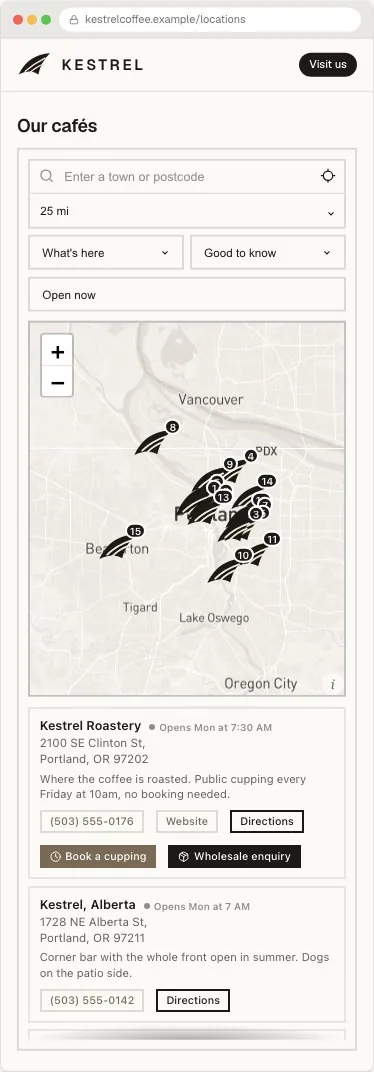
What a store locator actually calls
Three kinds of usage show up on the bill. Knowing which one your traffic drives is most of the estimate.
- Map loads. One each time the interactive map is drawn on a page. This scales directly with visits to the locator page.
- Geocoding. Turning an address into coordinates. A locator does this when locations are imported or edited, and again when a visitor types a town or postcode to search.
- Autocomplete. Suggestions as a visitor types in the search box, if the locator uses the provider's autocomplete product.
- Directions are usually free to you. A directions button that opens Google Maps or Apple Maps is a link to the visitor's own app, not a call on your key.
Google changed its pricing model in 2025
Until March 2025, Google gave every account a $200 monthly credit to spend across all its map products. Since 1 March 2025 each product has its own free monthly allowance instead. Most of the products a locator uses sit in Google's Essentials tier, which is where the allowances below come from, and the allowance resets on the first of each month.
Google also sells monthly subscription plans as an alternative to paying per request: Starter at $100 a month for 50,000 combined calls, Essentials at $275 for 100,000 and Pro at $1,200 for 250,000. They can work out cheaper at steady high volume. Everything else on this page is Google's pay-as-you-go pricing, the model that fits a locator without a fixed monthly commitment.
Google Maps Platform pay-as-you-go prices
Each product has a free monthly allowance, then a price per 1,000 requests that drops at each volume band. These are the bands a locator's traffic moves through.
| Product | Free each month | Then, per 1,000, by monthly volume |
|---|---|---|
| Dynamic map loads | 10,000 | $7.00 to 100,000, $5.60 to 500,000, $4.20 to 1,000,000, $2.10 to 5,000,000, $0.53 above 5,000,000 |
| Geocoding | 10,000 | $5.00 to 100,000, $4.00 to 500,000, $3.00 to 1,000,000, $1.50 to 5,000,000, $0.38 above 5,000,000 |
| Autocomplete requests | 10,000 | $2.83 to 100,000, $2.27 to 500,000, $1.70 to 1,000,000, $0.85 to 5,000,000, $0.21 above 5,000,000 |
Mapbox prices
Mapbox's free allowance for map loads is five times Google's, and its paid rate starts lower. Its standard geocoding for results you display gives 100,000 free requests a month. Mapbox also sells a permanent geocoding tier licensed for storing results, with no free allowance, but it is sold through its sales team rather than self-serve, so a new account is billed the standard rate.
Mapbox lists two price tables for its Search Box autocomplete product without saying which one a new account gets, so treat any Search Box figure as approximate. The calculator uses the higher, standard one.
| Product | Free each month | Then, per 1,000, by monthly volume |
|---|---|---|
| Map loads (GL JS) | 50,000 | $5.00 to 100,000, $4.00 to 200,000, $3.00 to 1,000,000, $2.50 above 1,000,000 |
| Geocoding, standard | 100,000 | $0.75 to 500,000, $0.60 to 1,000,000, $0.45 above 1,000,000 |
| Search Box sessions, standard | 2,500 | $11.50 to 100,000, $10.00 to 200,000, $8.40 to 500,000, $6.60 to 1,000,000, $6.60 above 1,000,000 |
Worked monthly costs for the map
Map loads only, at the published pay-as-you-go rates. Geocoding and autocomplete add a smaller amount on top; the map cost calculator itemizes all three for your own numbers.
| Map loads a month | Google Maps Platform | Mapbox |
|---|---|---|
| 5,000 | $0 | $0 |
| 25,000 | $105 | $0 |
| 60,000 | $350 | $50 |
| 150,000 | $910 | $450 |
| 500,000 | $2,870 | $1,550 |
Billing, keys and the demo key
Google requires a billing account for the Maps JavaScript API in production. Its Maps Demo Key is for prototyping only. New Google Cloud customers get a trial credit, which is separate from the monthly allowances above.
Mapbox lets you start without a card, but that is demo access with lower limits and a single token, and every product stops when a limit is reached. A production locator needs a payment method on the account.
Whichever you choose, restrict the browser key to the websites that host your locator. Google says plainly that you are responsible for charges from an unrestricted key that someone else uses.
- Restrict browser keys by allowed website origins
- Separate development and production credentials
- Set usage alerts and review provider logs
- Enable only the products the locator needs
- Rotate a key immediately if it is exposed
Which one to choose
Choose Google Maps when your visitors expect its familiar map, you already hold Google Cloud credits, or your traffic stays under its free allowance, where it costs the same as Mapbox: nothing.
Choose Mapbox when traffic is well past Google's free allowance or you want full control of the map's look. Handled Locator works with either on your own key, and you can switch provider later without rebuilding the locator. The map provider guide covers the connection steps.
Frequently asked questions
Is the Google Maps API free?
Partly. Each product has a free monthly allowance, 10,000 dynamic map loads for the map itself, and you pay per 1,000 past it. A billing account is still required to use it in production.
Does Google still give a $200 monthly credit?
No. Since 1 March 2025 each Google Maps Platform product has its own free monthly allowance instead of a shared $200 credit.
Is Mapbox cheaper than Google Maps for a store locator?
Usually, once traffic passes Google's free allowance. Mapbox gives 50,000 free map loads a month against Google's 10,000, and its first paid rate is lower. Below 10,000 loads a month both cost nothing.
Does my store locator vendor pay for the map?
It depends on the vendor. Some include map traffic in the subscription, some mark it up, and some, including Handled, let you use your own key so the provider bills you directly at its published rates.