
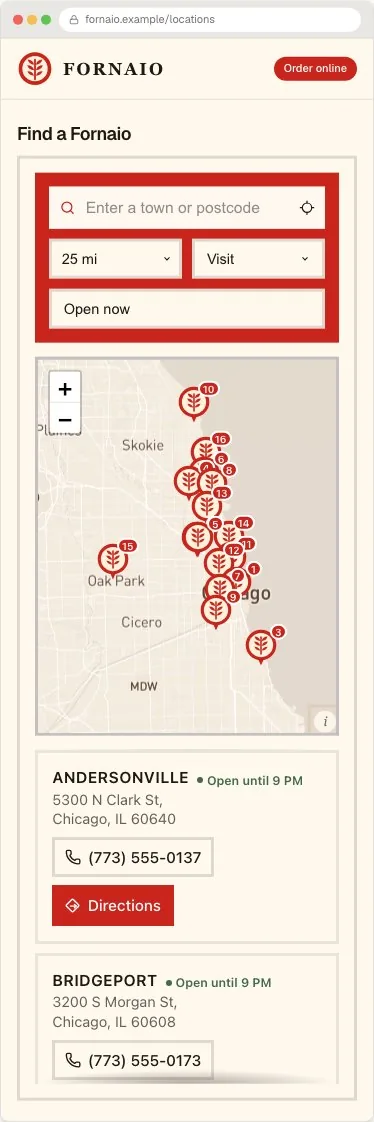
What makes a franchise locator different
Any brand where one name covers many independently run locations needs one: a quick-service chain like Domino's, where a visitor wants the nearest open store; a gym or salon franchise where services vary slightly by owner; a home-services franchise booking a local crew under a national brand. The mechanics match any store locator. What differs is that the data comes from dozens or hundreds of owners, each with their own habits, and the visitor holds the brand responsible for every one of them.
That shifts the hard questions from how it looks to who is allowed to change what, and how a franchisee's change reaches the page.
| Franchise category | Real examples of the shape | What visitors filter by |
|---|---|---|
| Quick-service restaurant | Domino's, Subway | Open now, delivery, drive-through |
| Fitness | Anytime Fitness, Orangetheory | Classes, amenities, open now |
| Hair and beauty | Great Clips, Supercuts | Services, walk-ins, booking |
| Home services | Local crews under one national brand | Service offered, whether they cover the address |
Define the shared record before you import
Write down the fields every location must have, their format and who owns each one, then import against that. A network that imports first and agrees the format later ends up with three phone formats, two spellings of every service and head office's address on a dozen branches.
| Field | Owned by | Notes |
|---|---|---|
| Location ID | Head office | A franchise or store number that never changes; needed for any sync |
| Public name | Head office | One naming pattern, such as Brand, Neighbourhood |
| Address and pin | Franchisee confirms | Check the pin lands on the entrance, not the car park |
| Phone, email, website | Franchisee | The location's own, not head office |
| Hours | Franchisee | One opening period per day, in the location's own timezone |
| Services and amenities | Head office defines the list, franchisee ticks | These become filters, so the list must be fixed |
| Order or booking link | Franchisee | Shown as a button on the card |
| Territory | Head office | Postcodes from the franchise agreement, if you route by territory |
Who edits what: roles instead of trust
Handled Locator has three roles, and they map closely to how a franchise system already divides responsibility. Editors change location data: records, categories, imports, syncs and Spotlight rules. Admins also change the locator itself: appearance, layout, wording and the team. Owners hold billing, API keys, map keys and webhooks. A regional operations lead can be an editor and fix any location's hours without being able to change the brand's colours or the visitor-facing wording.
Seats are per plan: 2 on Starter, 5 on Pro and 20 on Business. Roles apply to the whole account, not to single locations, so there is no setting that limits a franchisee to their own record. Most networks do not give every franchisee a seat for that reason. Franchisees send changes through a shared sheet or a form, and a small team of editors applies them.
Keeping franchisee details current
The most reliable pattern is a Google Sheet with one row per location, synced to the locator. Franchisees or regional managers edit their own rows; the sync applies clean changes on the schedule you choose and holds anything ambiguous for review. A row removed from the sheet never deletes a location, so a franchisee cannot take another's store off the map by mistake.
Hours need their own plan, because the sheet sync does not carry them. They are set per location in the dashboard, through the Location API on plans that include API keys, or by asking Claude or ChatGPT through the connector. Open-now status is worked out in each location's own timezone, which matters for a network across several time zones. Each day holds one opening period, so a location that closes between lunch and dinner service needs a deliberate choice about what to show.
Holiday closures are the classic franchise failure: the page says open, the door is locked. A Spotlight banner with a start and end date can carry a holiday-hours notice above the results and switch itself off afterwards, and a location that is closed for a longer period can be hidden and restored later.
Local actions: order, book, call
A franchise card should end in the action the visitor came for. For restaurants that is usually an order link, for salons and gyms a booking link, for home services a phone number. Each location's link is stored as a custom field and placed on the card as a button with its own label, colour and icon, so every location shows a consistent Book now button pointing at its own page in whatever booking system the franchisee uses. The appointment booking guide covers it, and clicks on those buttons are counted in analytics per location.
Territories, for franchises that sell them
Many franchise agreements grant a territory written as a list of postcodes. If yours do, the locator can respect them. A franchisee's territory is entered as postcodes, with prefixes allowed and exceptions carved out, and can arrive as columns in a CSV import. An address typed inside that patch resolves to the franchisee who holds it, either pinned above the rest or shown as the only result, depending on the mode you choose.
The optional enquiry form, off by default, extends the same rule to leads: a visitor's enquiry goes to the franchisee whose territory covers the address, then to a fallback location you set, then to the nearest. Territories apply to typed address searches; a visitor who uses their browser location is ranked by distance.
Test the journeys visitors actually take
Run these on a phone, on the published page, and repeat the first three after every large update.
- Search a city with several locations and confirm they sort by distance with open status readable at a glance.
- Turn on the Open now filter late in the evening and check that locations in another time zone answer correctly.
- Tap the order or booking button on three locations and confirm each reaches that location's own page, not head office.
- Search an address inside a franchisee's territory and confirm the right location is promoted.
- Call two numbers from the cards. A phone number that rings head office is the most common franchise data fault.
Where Handled Locator fits, and where it does not
Handled Locator suits a single-brand franchise network: one consistent design, locations from CSV or a synced sheet, role-based editing, booking and order buttons per location, territories by postcode, and 85+ settings to match the brand. Pro holds up to 2,000 locations and Business up to 10,000; pricing has the full plan list.
Two limits are worth knowing before you choose. An account serves one locator with one design, so a franchisor running several brands that must look different cannot run them from one account. And the locator does not generate a separate web page for each location; it is embedded in pages you already have. The restaurant locator overview shows the finished pattern for food franchises.
Frequently asked questions
What is a franchise locator?
A franchise locator is a store locator on a franchise brand's website that shows every location in the network, whoever owns it, sorted by distance from the visitor, with hours, open status and a local action such as ordering, booking or calling.
Can franchisees update their own location details?
Yes, through a shared workflow rather than direct website access. The usual setup is a synced Google Sheet where each franchisee edits their own row. Dashboard seats and roles apply to the whole account, so most networks keep dashboard access with a small team of editors.
How do I stop a franchisee from changing the brand design?
Give them an editor role, or no seat at all. In Handled, editors can change location data but not appearance, layout or wording, which need an admin.
How should holiday hours be handled in a franchise locator?
Keep regular weekly hours on each location and handle closures separately: a dated banner that switches itself on and off for network-wide holidays, and hiding a location for longer closures. Review hours before every major holiday.
Can a franchise locator respect exclusive territories?
Yes, if territories are written as postcodes. Each franchisee's postcodes are attached to their location, and a typed address inside that territory resolves to them, either promoted to the top or shown as the only result.